




Type & Profile Aren’t Enough: Why Homogenized Human Design Business Advice Fails
Jamie recently watched a thread where someone asked forty-plus Human Design “experts” how to market themselves based only on their type and profile — no mention of their offer, their financial goals, or how they actually want to sell. Not one person asked a follow-up question. That, Jamie argues, is exactly what’s wrong with most Human Design business advice: it treats type and profile as the whole answer, when they’re really just the starting point.
This isn’t a minor critique. It gets at the core failure mode of the Human Design-for-business space: reducing a complex, layered chart down to a single formula that’s supposed to apply to everyone who shares a type or profile. It doesn’t — and the gap between that formula and reality is where a lot of unnecessary business suffering happens.
Same Chart, Wildly Different Businesses
Jamie shares the example of a childhood friend born the same day, in the same hospital, minutes apart — both 3/5 Triple Split Energy Projectors, same determination, same environment. He runs a vacation rental business. She runs an education and coaching business. Their charts are nearly identical, and their marketing looks nothing alike, because marketing is never just about type and profile. It’s about the offer, the price point, the sales approach, and the person’s actual desires and lifestyle.
The Robustness Equation
If your goal is to make $250,000 a year selling a $100 product, that’s roughly 2,500 sales — about seven people a day. At industry-average cold traffic conversion rates (around 2%) and warm traffic rates (4-15%), that tells you exactly how much traffic and visibility your business ecosystem actually needs. Skip this math, and you’ll set expectations your current ecosystem simply can’t meet — which is where most of the suffering in online business actually comes from: a mismatch between reality and expectation.
How Robust Does Your Ecosystem Need to Be?
Before you can answer “how do I market this,” you need clarity on a handful of upstream questions. The answers change everything downstream — the content strategy, the sales process, even how visible you need to be day to day:
- How you want to sell (high volume vs. high ticket, low volume)
- Your financial goals and current offer suite
- Your defined centers, determination, and environment — not type/profile alone
- What season of life you’re in and what resources you already have
None of these questions have a right answer dictated by your type or profile. A projector and a manifesting generator can both build a high-volume, low-ticket business, or both build a low-volume, high-ticket one — the deciding factors are the offer, the goal, and the person’s actual desire for how they want to spend their time, not the chart alone.
The Success Equation
Type and profile alone are better than nothing — but they’re incomplete. A real success equation includes your full Human Design chart (determination, environment, centers, color, perspective), your financial goals, how robust your ecosystem needs to be to hit those goals, and — underneath all of it — genuine clarity on what you actually desire for your business and your life.
The Cost of Skipping This Math
Most of the suffering Jamie sees in online business doesn’t come from a bad offer or a weak Human Design fit — it comes from a mismatch between expectation and reality. Someone sets a revenue goal, assumes their current list or following is “enough,” and never runs the actual numbers connecting goal, price point, and conversion rate. When the results don’t match the expectation, the instinct is usually to blame the offer, the marketing, or the person’s design — when the real issue was skipping the robustness equation from the start. Jamie also recommends every business include what she calls an experience offer: a low-ticket, high-value entry point that converts in the 2-5% range and builds trust for higher-ticket offers down the line.
Frequently Asked Questions
Can two people with the same Human Design type and profile need different business models?
Yes. Type and profile shape natural tendencies, but the right business model also depends on your offer, price point, financial goals, defined centers, and how you personally want to sell — none of which are determined by type and profile alone.
What is the robustness equation in business?
It’s the math connecting your financial goal, your price point, and realistic conversion rates to determine how much traffic, volume, and visibility your business ecosystem actually needs to hit that goal.
Why do “all projectors should do high ticket” or similar type-based rules fail?
Because they ignore everything else in the chart and in the person’s life circumstances. A blanket rule based on type alone (or profile alone) will be wrong for a meaningful percentage of the people it’s given to.
What is an “experience offer” and why does every business need one?
An experience offer is a low-ticket, high-value entry point — typically converting in the 2-5% range — that lets people experience the value of working with you before committing to a higher-ticket offer, improving conversion at every stage after it.
What is the DDL Framework?
DDL stands for Design, Desires, and Lifestyle — Jamie’s framework for finding the intersection of what your Human Design chart supports, what you actually want, and how you want your day-to-day life to look, rather than building a business around design alone.
Go Deeper
This is exactly what Jamie walks through inside Business Design Day using the DDL Framework (Design, Desires, Lifestyle) — helping you get clear on your robustness equation and success formula. Details and registration: enroll here.
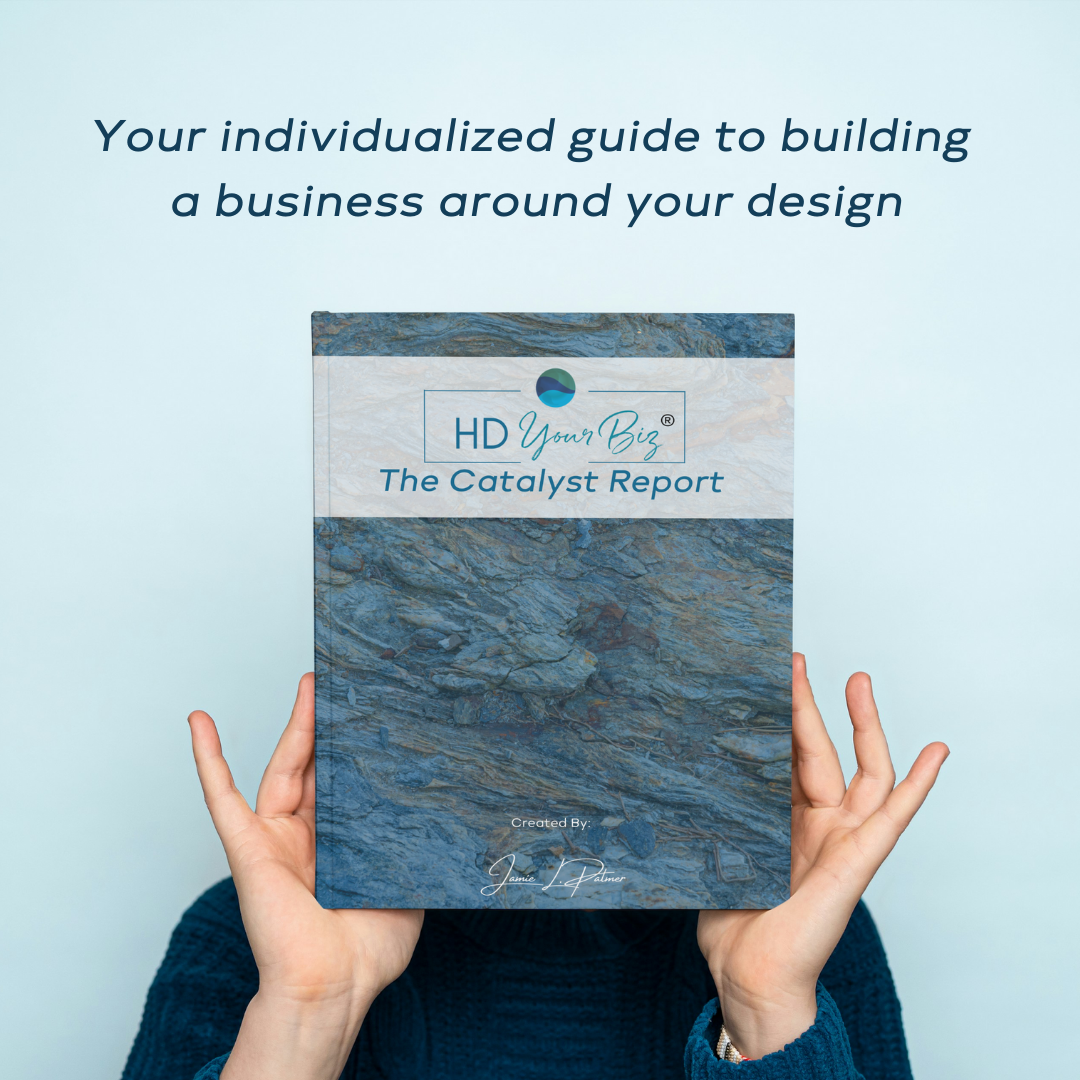
Or get your personalized starting point with a Catalyst Report: https://humandesignyourbusiness.com
Build a Business At the Intersection of Your Design, Desires, and Lifestyle
Ready to build at the intersection of your Design, Desires, and Lifestyle? The HD Your Biz Catalyst Report gives you a personalized roadmap — and ordering in April gets you a ticket to Business Design Day Live on April 30th, where Jamie is teaching the DDL Framework for the first time.


Recent Comments